
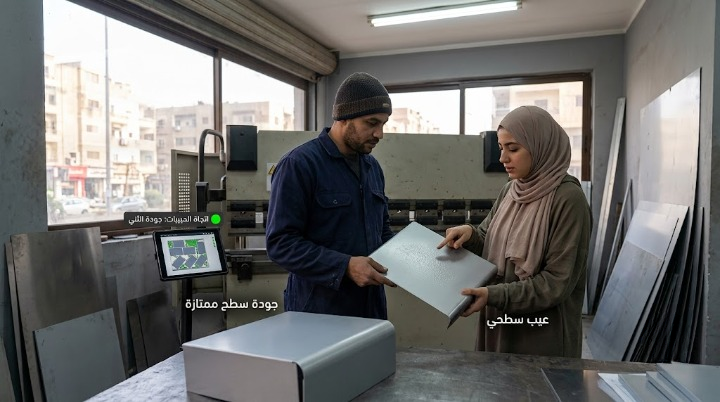
Workshop managers ignoring grain direction during nesting layout can discover that a portion of bent panels exhibit visible surface texture defects unacceptable for exposed cassette faces on the building.
Why Grain Direction Affects How Material Responds to Bending
Aluminum sheet material exhibits directional properties from its rolling process — bending across the grain direction behaves differently than bending along it, for most alloys producing a cleaner bend when oriented correctly. This is a real material property, not a minor theoretical consideration, and it directly affects the visible surface quality of the finished bend.
Where This Consideration Gets Left Out of Nesting
Nesting algorithms and manual layout processes focused primarily on maximizing sheet utilization can overlook grain direction constraints entirely, orienting panels for optimal material yield without considering how that orientation will affect bend quality once the panel is folded.
Why This Surfaces as a Visible Defect on Exposed Surfaces
A panel bent against its optimal grain orientation can develop a visible surface texture defect — sometimes described as an orange-peel appearance — that may be acceptable for a hidden return but is not acceptable for a cassette face that will be visibly exposed on the finished building facade.
Automatically Orienting Panels for Optimal Bend Quality
After explaining how grain direction affects bend quality across most alloys, the fix is incorporating grain direction as a nesting constraint alongside material yield optimization, rather than treating them as separate, competing considerations. Clad Cut V2’s nesting algorithm includes grain direction constraints that automatically orient panels for optimal bend quality while still maximizing sheet utilization.
Validate your grain orientation strategy — Audit Clad Cut V2’s nesting logic.