
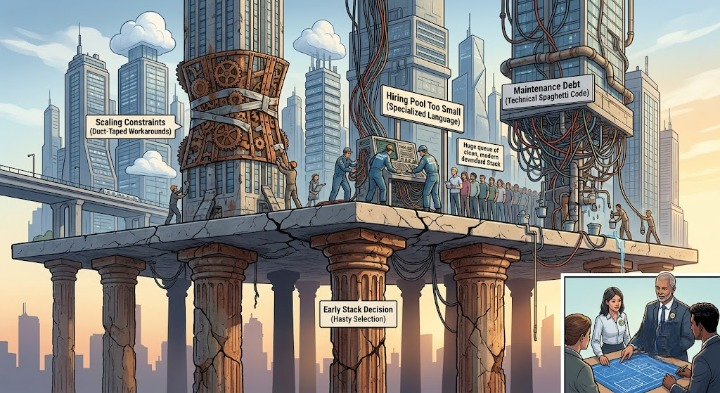
A tech stack decision made in the first week of a project can quietly constrain that product for years — and the constraint rarely becomes visible until scaling or hiring makes the original choice difficult to work around.
Why Stack Decisions Are Rarely Revisited
Once a technology stack is chosen and initial development is underway, revisiting that decision becomes progressively more expensive. This creates a strong incentive to live with an early stack choice even after its limitations become apparent, because the perceived cost of switching feels higher than the cost of continuing to work around the constraint.
What Gets Overlooked at Selection Time
Stack decisions are frequently made based on developer familiarity or what a founding team already knows, rather than a structured evaluation of long-term maintainability, hiring pool availability, or how well the ecosystem’s tooling will support the product’s eventual scale. Each of these factors is difficult to assess in the moment a team is choosing a stack under time pressure, and easy to underweight relative to “can we start building today.”
Where the Constraint Becomes Visible
The consequences of an early stack decision typically surface later — when a company needs to hire specialized developers for a niche framework and discovers the talent pool is smaller than anticipated, or when a product needs a capability the chosen ecosystem does not support well, forcing an expensive workaround or migration.
Evaluating Stack Decisions Against Long-Term Business Outcomes
After outlining the criteria that should drive stack selection beyond short-term convenience, the fix is bringing in a structured evaluation before committing, one that weighs long-term maintainability and hiring considerations alongside initial development speed. DomApp’s Adaptive Agile Development consulting serves as the advisory layer that evaluates stack decisions against long-term business outcomes, rather than leaving that evaluation to whichever framework a founding team happens to already know.