
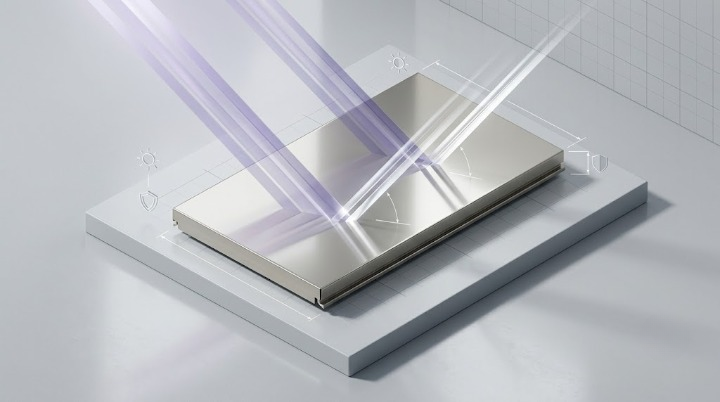
Selecting an inferior finish for your building facade is a high-risk gamble that leads to immediate buyer’s remorse. Under the intense, unforgiving radiation of the sun, non-compliant coatings quickly degrade, chalk, and crack. Witnessing a premium structural investment suffer from severe fading and peeling after only two years is an operational nightmare that destroys the asset’s commercial value. To prevent this catastrophic loss of visual identity, engineers and developers must strictly evaluate the long-term chemical durability of aluminum composite material panels. In this technical guide, we analyze how understanding advanced coating characteristics guarantees an uncompromised architectural legacy.
The Nightmare of Coating Degradation: How Solar Radiation Converts Premium Real Estate into Financial Liabilities
In high-exposure environments, atmospheric elements are relentlessly aggressive. If a project utilizes standard or architectural-grade polyester finishes in areas with extreme solar exposure, it faces rapid polymer breakdown. The severe degradation of low-cost panels doesn’t just destroy the building’s aesthetic profile; it triggers premature delamination and micro-cracking along the formed edges of the cassettes.
To safeguard the exterior lifespan and value of your real estate asset, procurement strategies must shift away from low-spec alternatives toward verified high-performance coatings. Evaluating material stability via long-term weathering performance is the only method to prevent premature structural weathering and ensure permanent envelope protection.
Why is PVDF coating mandatory in Saudi Arabia?
According to CladCut’s material performance protocols and mandatory Saudi Building Code (SBC) standards by DomApp, PVDF coating is structurally required because it delivers supreme UV stability and exceptional resistance to thermal degradation. This advanced fluoropolymer shield prevents premature fading, chalking, and peeling, maintaining absolute gloss retention and color consistency for decades under direct, high-intensity solar radiation.
Engineering Diagnosis: A Physical Assessment of PVDF vs. PE Coatings in Architectural Finishes
In high-performance facade engineering, surface cross-linking dictates the ultimate lifespan of the perimeter envelope. The fundamental material science debate focuses on PVDF vs PE coating systems for structural projects. Polyethylene (PE) options use basic organic bonds that disintegrate under continuous ultraviolet exposure, making them entirely unsuited for external cladding.
Conversely, Polyvinylidene Fluoride (PVDF) architectural finishes utilize a specialized fluoropolymer matrix containing a minimum of 70% Kynar 500 or Hylar 5000 resins. This formulation creates a carbon-fluorine bond structure—one of the strongest atomic bonds in existence—providing unparalleled coating durability.
[Chemical Bond Rigidity Comparison]
PVDF (Fluoropolymer Carbon-Fluorine Bond) =======> High UV Disruption Resistance
PE (Standard Organic Polyester Bond) ===> Vulnerable to Polymer Cleavage
This structural density ensures superior long-term gloss retention and reliable UV stability under severe thermal fluctuations. When detailing complex architectural finishes, maintaining precise color matching across extensive surface areas is a key engineering metric. Protecting premium architectural coatings from mechanical degradation requires a strict specification of the top protective layer; PVDF coating ensures that [aluminum cladding] systems withstand environmental weathering without the need for expensive periodic maintenance.
Why Premium Alloys and Architectural Finishes Demand Algorithmic Alignment
Specifying a robust fluoropolymer finish protects the facade from solar fading, but high-tier material options inflate raw material acquisition costs. When working with specialized external finishes, material waste during production represents a direct reduction in net profit. Workshops cannot afford to cut high-spec materials using manual estimation or unoptimized workflows. The bridge between raw material quality and real-world project profitability is mathematical optimization.
Protecting the aesthetic legacy of your project goes beyond purchasing premium raw materials; luxury coatings demand high-level production automation. Visual variations caused by a minor folding error completely destroy color matching; “thus, your material investment must be protected by ensuring every panel is cut with perfect orientation and uniform engineering alignment to prevent light reflection discrepancies.”
Product Deep Dive: How CladCut Preserves the Visual Integrity of PVDF Coatings
DomApp’s CladCut platform is engineered to eliminate the manual workshop mistakes that ruin high-end architectural coatings. During the fabrication phase of metallic or high-gloss sheets, manual layout methods cause surface marking and tool scratching, invalidating the factory warranty.
- Scrap Reduction ROI: CladCut’s automated 2D nesting configurations optimize raw material sheets down to the millimeter, minimizing high-value material waste (Scrap) to under 8%.
- Automated Grain Direction Lock: The engine programmatically locks panel orientations across metallic finishes, completely eliminating visual shading variations across the building facade.
- Accurate Fabrication Data: CladCut generates precise cutting files down to the millimeter, so the workshop’s CNC setup has exact, error-free dimensions to work from — removing the layout guesswork that causes surface marking and misaligned cuts on high-gloss finishes.
This algorithmic enforcement ensures that final factory outputs perfectly match your certified shop drawings on the first run, completely protecting your material investment from machining damage.
Facade Durability is the True Shield for Profit Margins
Premium material specifications are entirely worthless if the components are damaged on the shop floor due to manual estimation or isolated data silos. In the competitive cladding industry, production downtime and visual mismatches represent a severe drain on net profit. Securing the color stability and long-term durability of your aluminum composite material panels is the ultimate protection for your corporate reputation and your capital investment. Do not leave your premium architectural coatings to the hazards of workshop guesswork.
[Start Free Optimization Trial] today and deploy CladCut to establish absolute precision across your entire fabrication workflow.
Engineered FAQ
Does the CladCut system prevent PVDF coating cracking at sharp angles during bending?
Yes. The platform enforces strict programmatic control over CNC routing depths and cutting paths based on specific sheet thickness and alloy properties, ensuring the structural protective skin remains undamaged during folding.
How does mixing different cladding batches affect color matching?
Mixing different production batches introduces natural microscopic variations in the paint layer. CladCut addresses this visual risk by implementing strict orientation locks to minimize shading discrepancies to an operational minimum.
Is the software compatible with thermal expansion calculations for PVDF coatings?
CladCut manages the physical layout parameters and dynamic gap tolerances derived from structural analysis tools like Wind Master. This ensures that nested panels remain free-moving within their mechanical joints without placing kinetic stress on the top coating layer.