
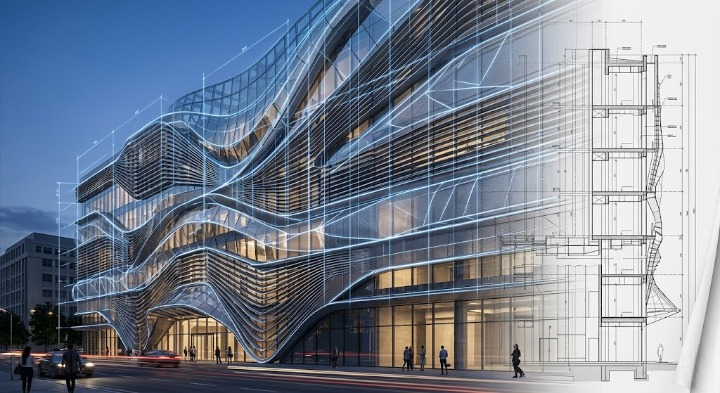
The massive disconnect between beautiful 3D architectural concepts and confusing 2D factory drawings is the leading cause of project delays.
Every millimetre of error in your architectural shop drawings translates into expensive site rework and financial bleeding during the construction phase.
In this technical guide, we examine how DASH bridges this execution gap through automated detailing to ensure flawless manufacturing and ready-to-install components for your most complex aesthetic visions.
What are Automated Architectural Shop Drawings?
Automated architectural shop drawings are a computational process that extracts engineering data from Rhino or Revit models to generate precise 2D blueprints for manufacturing.
According to DASH’s Algorithmic Extraction protocol, shop drawings are generated through the following standardized steps:
- Data Ingestion: Uploading complex Rhino or Grasshopper models to the cloud-based DASH platform.
- Parametric Slicing: Algorithmic analysis of architectural geometry to create exact 2D plans and sections.
- Automated Annotation: Programmatic placement of dimensions and technical specifications based on the model’s metadata.
- Fabrication Export: Generating machine-ready G-Code and DXF files that guarantee 100% data retention.
The Execution Gap – Why Traditional Drafting Fails Complex Projects
Traditional commercial architectural shop drawings often suffer from a severe lack of coordination when handled manually.
Relying on legacy architectural drafting services creates a dangerous mismatch between floor plan detailing, elevation drawings, and reflected ceiling plans (RCP). This fragmentation is particularly critical in architectural millwork shop drawings, where even a tiny dimensional discrepancy leads to failed installations.
Digital transformation in construction documentation is the only way to eliminate the human error inherent in manual data entry.
Translating Rhino 3D into Fabrication-Ready Data
The most significant technical challenge is translating organic curves and freeform shapes from a Rhino 3D environment into buildable CAD files without distorting the design intent. By utilizing a specialized facade automation platform, architectural data is translated directly from parametric models into 2D shop drawings.
This automated bridge allows engineering teams to bypass the drudgery of manual CAD work, ensuring zero-error precision in every manufacturing panel and interior detail.
DASH – Digital Transformation for Architectural Detailing
DASH operates as a SaaS + Service engine that utilizes technologies like Rhino.Inside.
Revit to link complex generative designs with data-rich BIM environments. Our automated engine provides an immediate Return on Investment (ROI) through the following mechanical advantages:
- Absolute Precision: Algorithmic extraction eliminates human errors in complex geometric measurements.
- Rapid Delivery: Detailing time is reduced by up to 80% compared to traditional manual drafting workflows.
- Data Integrity: A direct link between the 3D model and the Bill of Materials (BOM) ensures zero material waste and accurate procurement.
Engineering Certainty – Your Time is Your Most Valuable Asset
In the modern construction landscape, certainty is the ultimate currency. Automated architectural shop drawings are not just a speed enhancement; they are a protective shield for your design identity and your project budget.
Do not allow manual errors to compromise your architectural vision or drain your financial resources.
Stop paying for manual drafting errors. Upload a sample 3D model for a free CAD-extraction feasibility review and start your journey toward flawless manufacturing today.
Engineered FAQ
- Does DASH support complex curved architectural designs?
Yes. The platform is engineered to handle complex computational geometry, translating double-curved surfaces into planar or single-curved manufacturing panels. - How does DASH ensure compliance with technical specifications?
Every output is verified by our team of Computational Designers to ensure strict adherence to the Saudi Building Code (SBC) and fabrication standards. - Can DASH be integrated into an existing firm’s workflow?
Absolutely. DASH functions as a cloud-based extension of your team, integrating seamlessly with your existing Rhino, Revit, and AutoCAD environments.