
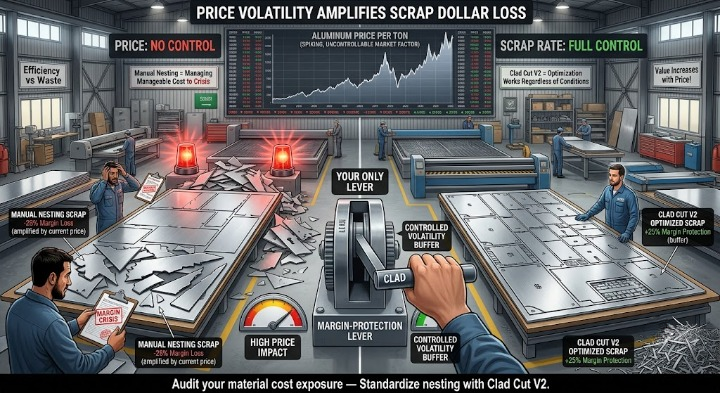
ACP fabricators watching raw aluminum prices spike while manual nesting continues wasting a significant share of every sheet are turning a manageable cost increase into a margin crisis.
Why Scrap Rate Determines How Price Volatility Affects Margin
Aluminum price is a market factor entirely outside any individual fabricator’s control. Scrap rate, however, is a factor the fabricator directly controls — and it determines how severely a given price increase actually affects margin, since every percentage point of scrap waste is amplified by whatever the current material price happens to be.
Where This Amplification Becomes Most Painful
During periods of rising aluminum prices, a fabricator’s existing scrap rate — which may have felt like a tolerable cost when prices were lower — suddenly represents a much larger absolute dollar loss, even though the percentage of material wasted has not changed at all.
Why This Makes Scrap Reduction the Only Available Lever
Because price itself cannot be controlled, and reducing project scope or quality is rarely a viable option, scrap reduction becomes the primary lever a fabricator can actually pull to protect margin during a period of rising material costs — making nesting efficiency more valuable precisely when prices are highest.
A Margin-Protection Lever That Works Regardless of Market Conditions
After showing how material price volatility amplifies the impact of every percentage point of scrap, the fix is optimizing nesting specifically because it is the one variable within direct control. Clad Cut V2’s nesting optimization is positioned as the margin-protection lever that works regardless of market conditions, delivering its greatest relative value precisely when aluminum prices are highest.
Audit your material cost exposure — Standardize nesting with Clad Cut V2.