
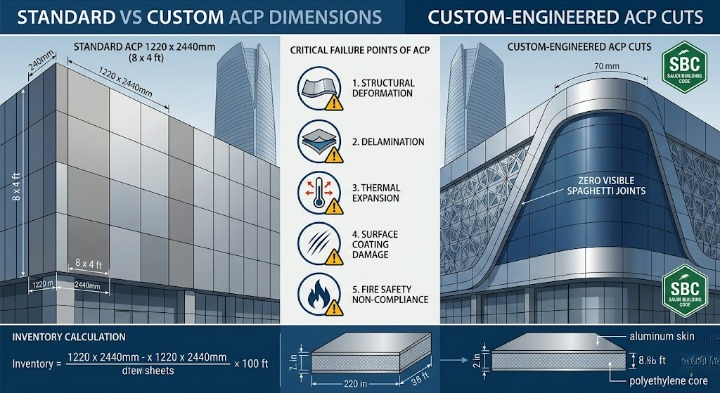
In the high-stakes world of architectural facades, the choice between standard ACP (Aluminum Composite Panel) dimensions and custom-engineered cuts is rarely just about logistics—it’s a financial pivot that determines the Return on Investment (ROI) and the long-term structural integrity of the project. While standard sizes offer the comfort of immediate availability, custom fabrication serves as the “Architectural Guard” against excessive labor and material waste.
Standard ACP Dimensions and Application Range
Standard sheets provide a baseline for most commercial and residential applications. Selecting the right standard size is about balancing man-power with structural “Technical Certainty.”
| Standard Size (mm) | Foot Equivalent (Approx.) | Optimized Application |
| 1220 x 2440 | 8 x 4 | Signage, interiors, and surfaces under 1,000 sq. ft. |
| 1250 x 3000 | 10 x 4 | Efficient for low-rise commercial projects with standard floor heights. |
| 1500 x 3000/4000 | — | Tall structures; strategically minimizes vertical seams and joint lines. |
| 1500 x 5000 | — | High-rise facades; requires specialized suction-lifting infrastructure. |
When to Specify Custom Cuts – The Strategic Pivot
Custom fabrication is a necessity when “close enough” isn’t an option. In 2026, where building codes like the SBC (Saudi Building Code) demand higher precision, custom cuts eliminate the “Technical Debt” of poorly fitted panels.
- Unique Geometries: Essential for unusual installation spaces, curved facades, or intricate decorative patterns where standard rectangles create unsightly “Spaghetti Joints.”
- High-Rise Requirements: For buildings exceeding six floors, custom sizes are engineered specifically to withstand localized Wind Loads, ensuring the panels don’t experience “oil-canning” or structural fatigue.
- Large-Scale Facades: Modern architecture often demands visual continuity. Sheets up to 15 feet wide are achievable, effectively reducing the number of mechanical weak points (joints) across the building’s skin.
The Engineering Formula for Inventory Calculation
To ensure procurement accuracy and prevent “Inventory Mismatch,” use the following formula:
{Required Sheets} = \left( \{\text{Total Facade Area}}{\text{Coverage Area of One Sheet}} \right) + 10\% \text{ (Buffer for damage and cut-offs)}
Aluminum ACP Sheet Fabrication – Eliminating Production Failures
Fabrication failures are rarely just a result of poor workmanship; they are often the result of a mismatch between material logic and application. Achieving Zero-Defect production requires addressing these five critical failure points:
1. Structural Deformation and Warping
Waviness on the facade surface is often a symptom of choosing a thin aluminum skin for a high-wind-load environment.
- Prevention: Match panel rigidity to the specific building height and ensure strict flatness control during the CNC routing and fabrication process.
2. Delamination and Bonding Failure
Separation of the aluminum skin from the polyethylene or mineral core is a catastrophic failure that compromises safety.
- Prevention: Only utilize panels that have passed rigorous peel strength tests. Ensure that routing is deep enough for bending but does not compromise the adhesive bond.
3. Thermal Expansion Miscalculation
ACP panels are “living” materials that expand and contract. Ignoring this leads to buckled panels or sheared fasteners.
- Prevention: Implement Floating Installation Systems. Allow for specific expansion gaps based on the local peak-to-peak temperature fluctuations.
4. Surface Coating Damage
Scratches or premature fading turn a premium project into a maintenance liability.
- Prevention: Specify UV-resistant coatings (like PVDF) and enforce a strict protocol: Do not remove protective films until the final site cleanup.
5. Fire Safety Non-Compliance
Using combustible cores in high-rise structures is more than a technical error—it’s a critical safety breach.
- Prevention: Specify FR Class A2 (90% mineral content) or Class B (70% mineral content) cores to ensure compliance with global fire safety standards.
⚠️ CAUTION – CRITICAL FABRICATION ERRORS
- Incorrect Fasteners: Using mismatched screws or rivets leads to panel loosening in seismic zones or high-vibration areas.
- Poor Weather Sealing: Skipping UV-resistant sealants causes water ingress, leading to sub-structure corrosion.
- Improper Storage: Stacking panels on uneven ground or exposing them to moisture before installation can lead to permanent dents or surface discoloration.