
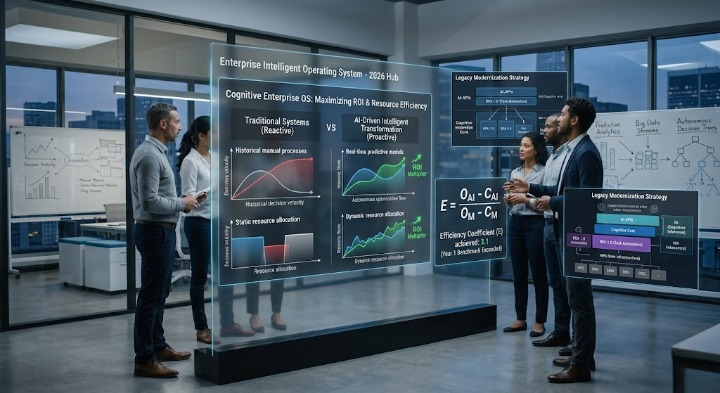
In 2026, the concept of digital transformation has evolved from mere “process digitization” to “process intelligence.” The objective is no longer simply migrating data to the cloud, but building cognitive systems capable of autonomous decision-making. These systems multiply Return on Investment (ROI) by eliminating operational waste and optimizing resource allocation with surgical precision.
AI-Driven Digital Transformation Models
Leading enterprises today integrate AI into the very core of their “Operating System” rather than treating it as a secondary add-on. This structural integration is what separates market leaders from legacy followers.
1. Intelligent Automation (IA)
Intelligent Automation transcends the boundaries of traditional Robotic Process Automation (RPA). While RPA handles repetitive, rule-based tasks, IA simulates human analytical and inferential capabilities.
- Cognitive Recognition: The ability to perceive and understand unstructured data (text, images, video).
- Autonomous Decision-Making: Utilizing machine learning algorithms to determine the optimal course of action without human intervention.
2. Modernizing Legacy Systems
The greatest bottleneck to scaling in 2026 remains antiquated infrastructure. Intelligent transformation does not always require a total “rip-and-replace” approach. Instead, it involves building layers of AI-APIs that act as a bridge, allowing legacy systems to interact seamlessly with emerging technologies.
The Engineering Formula for Operational Efficiency
From a technical standpoint, the success of a digital transformation initiative can be measured by the Efficiency Coefficient ($E$), defined as:
E = \frac{O_{AI} – C_{AI}}{O_{M} – C_{M}}
Where:
- $O_{AI}$: Output generated using Artificial Intelligence.
- $C_{AI}$: Operational cost using Artificial Intelligence.
- $O_{M} / C_{M}$: Output and cost associated with traditional manual systems.
The benchmark for 2026 is to achieve an efficiency coefficient exceeding 2.5 within the first year of implementation.
The Future – Data-Driven Decision Sovereignty
Big Data is the fuel, but AI is the engine. The future of enterprise management rests on Predictive Analytics, allowing leadership to see operational obstacles weeks before they manifest.
| Feature | Traditional Transformation | Intelligent Transformation (2026) |
| Data Type | Structured data (tables/spreadsheets) | Comprehensive data (text, behavior, sensors) |
| Decision Velocity | Reactive (responding to past events) | Proactive (anticipating future needs) |
| Scalability | Requires proportional labor increases | Exponential Scaling |
| Performance Accuracy | Dependent on human input precision | Self-enhancing via continuous learning |