
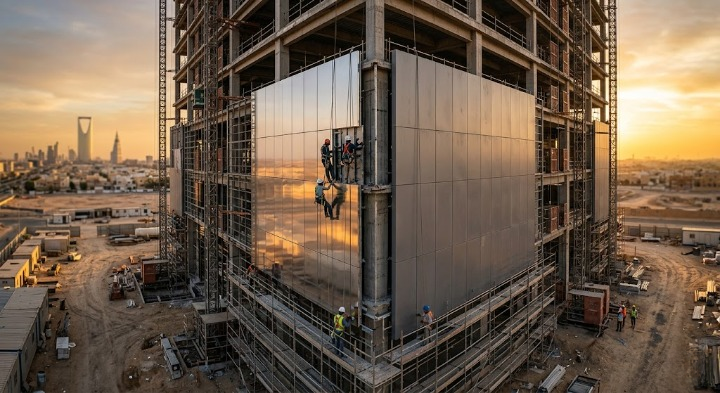
In modern construction, the materials used in building projects play a crucial role in determining the structural and aesthetic performance. Among these materials, ACP (Aluminum Composite Panels) and Solid panels are popular choices in the cladding sector. But what sets them apart? And which one is best suited for your project?
This article provides a detailed comparison between ACP panels and Solid panels in terms of weight, durability, flexibility, cost, and other key factors that matter to engineers and contractors in Saudi Arabia.
What Are ACP Panels?
Structural Composition of ACP Panels
Aluminum Composite Panels (ACP) consist of two aluminum layers enclosing an inner core made of plastic or metal materials. This composition provides lightweight properties with high durability.
Materials Used in ACP Manufacturing
- Aluminum: Used as the outer layer for protection and aesthetics.
- Plastic Materials: Serve as the inner core, providing thermal and sound insulation.
- Protective Coatings: Includes weather-resistant and UV-resistant coatings.
Physical and Engineering Properties of ACP Panels
✅ Lightweight: Easy to transport and install.
✅ Durability: Resistant to corrosion and rust.
✅ Flexibility: Can be bent and shaped easily.
What Are Solid Panels?
aluminum solid panels:
Solid aluminum panels are a popular choice for cladding due to their many strengths, but they also have some drawbacks to consider. Here’s a breakdown of the pros and cons:
Advantages:
- Durability and weather resistance: Solid aluminum stands up well to the elements. It’s resistant to rust, corrosion, and can withstand rain, snow, and UV rays for decades without significant deterioration. This translates to a long lifespan for your building’s facade.
- Low maintenance: Unlike wood or other claddings, solid aluminum requires minimal upkeep. Regular cleaning may be necessary to maintain its appearance, but it won’t need repainting or resealing frequently.
- Lightweight: Aluminum is a lightweight material, which makes it easier to install and puts less strain on the building’s structure. This can be a significant advantage for tall buildings or those with complex designs.
- Fire resistance: Solid aluminum panels are non-combustible, which can be a crucial safety feature for buildings.
- Versatility: Aluminum panels can be fabricated into a wide variety of shapes and sizes, and they come in a broad range of colors and finishes. This allows for creative architectural designs.
Disadvantages:
- Susceptibility to dents and scratches: Aluminum is a soft metal, so it can be dented or scratched more easily than some other cladding materials. While thicker panels and protective coatings can help mitigate this, dents can be difficult or impossible to repair.
- Cost: While the initial cost of aluminum panels might be lower than some materials, the need for professional installation and potential maintenance costs over time can add up.
- Thermal conductivity: Aluminum conducts heat well. In hot climates, this can lead to a building absorbing more heat, increasing cooling costs. However, this can be a benefit in cold climates where it helps dissipate heat. In either case, additional insulation may be needed to achieve optimal thermal performance.
- Oil canning: Large, thin panels can develop a wavy surface known as “oil canning” due to temperature fluctuations. This can be a cosmetic issue and may be less noticeable with thicker panels or specific design features.
Overall, solid aluminum panels offer a good balance of durability, aesthetics, and ease of maintenance. However, it’s important to weigh the potential drawbacks, such as dent susceptibility and cost, to see if they align with your project’s priorities.
Comparison Between ACP Panels and Solid Panels
| Feature | ACP Panels | Solid Panels |
| Composition | Aluminum & plastic core | Solid materials like metal or wood |
| Weight | Lightweight, easy to handle | Heavy, requires strong support |
| Durability | Resistant to corrosion but prone to dents | More durable against impacts |
| Flexibility | Easily bendable and shaped | Hard to shape and modify |
| Installation Cost | Lower cost, easier installation | Higher cost due to weight |
| Aesthetic Appeal | Modern and sleek appearance | Traditional and strong |
Weight Comparison Between ACP Panels and Solid Panels
Which One Is Lighter?
ACP panels are significantly lighter than Solid panels, making them an ideal choice for high-rise buildings where weight is a critical factor.
Impact of Weight on Installation and Structural Support
- ACP Panels: Require minimal support structures, reducing overall construction costs.
- Solid Panels: Require stronger support systems, increasing material and labor costs.
Durability and Resistance to Environmental Factors
Moisture and Water Resistance
- ACP Panels: Water-resistant but may degrade if improperly sealed.
- Solid Panels: Highly resistant to moisture and water damage.
Wind and Air Pressure Resistance
- ACP Panels: Good wind resistance but may deform under extreme pressure.
- Solid Panels: Excellent resistance to strong winds and pressure.
Corrosion and Rust Resistance
- ACP Panels: Coated to prevent corrosion.
- Solid Panels: Require periodic maintenance to prevent rust.
Flexibility and Ease of Shaping
| Feature | ACP Panels | Solid Panels |
| Design Flexibility | Can be shaped and bent easily | Hard to modify |
| Application in Complex Designs | Suitable for intricate architectural designs | Limited design options |
🔹 ACP panels allow for modern and creative designs.
🔹 Solid panels are less flexible, restricting design choices.
Cost Analysis: ACP vs. Solid Panels
Raw Material Cost
- ACP Panels: Lower cost of raw materials.
- Solid Panels: Higher cost due to solid composition.
Installation and Maintenance Costs
- ACP Panels: Lower installation cost but requires periodic maintenance.
- Solid Panels: Higher installation cost but less maintenance needed.
Installation Methods for ACP and Solid Panels
Mechanical vs. Adhesive Fixing
- ACP Panels: Can be mechanically fixed or glued.
- Solid Panels: Require mechanical fixing Can be fixed by Glue also only.
Visible vs. Hidden Fixing Systems
- ACP Panels: Can be installed with hidden fixing systems for a sleek appearance.
- Solid Panels: Often require visible fixings.
Applications of ACP and Solid Panels in Construction
Usage in Residential and Commercial Buildings
- ACP Panels: Used in modern building facades for residential and commercial projects.
- Solid Panels: Common in industrial and high-strength structures.
Role in Architectural Facades
- ACP Panels: Provide a modern and stylish look.
- Solid Panels: Offer a traditional and robust appearance.
Thermal and Acoustic Insulation Performance
| Feature | ACP Panels | Solid Panels |
| Thermal Insulation | Higher due to the plastic core | Lower insulation |
| Acoustic Insulation | Good soundproofing | Less sound insulation |
🔹 ACP panels provide better thermal and sound insulation.
Maintenance Requirements: ACP vs. Solid Panels
| Aspect | ACP Panels | Solid Panels |
| Maintenance Needs | Requires regular cleaning and checks | Less maintenance required |
| Lifespan | Long-lasting with proper maintenance | Generally longer lifespan |
Environmental Impact and Sustainability
Which One Is More Eco-Friendly?
- ACP Panels: Can be easily recycled, making them environmentally friendly.
- Solid Panels: Harder to recycle, making them less sustainable.
Fire Resistance and Safety
- ACP Panels: Fire-resistant with protective coatings.
- Solid Panels: Higher fire resistance due to solid composition.
Regulations and Standards for ACP and Solid Panels in Saudi Arabia
- Compliance with Saudi building codes.
- Meeting thermal and sound insulation standards.
- Ensuring safety regulations are met.
Future Trends in ACP and Solid Panel Usage
- Innovative Manufacturing Technologies to enhance performance.
- Sustainable Material Development for eco-friendly buildings.
- AI-Driven Installation Techniques to improve efficiency.
Case Studies: Successful Projects Using ACP and Solid Panels
- ACP Panels: Used in modern facades and skyscrapers.
- Solid Panels: Preferred for industrial and structural-heavy projects.
When Should You Choose ACP Panels?
Best suited for:
✔ Lightweight structures.
✔ Complex designs.
✔ Cost-effective solutions.
When Should You Choose Solid Panels?
Best suited for:
✔ High-impact durability.
✔ Industrial and structural buildings.
✔ Long-term sustainability.
FAQs: ACP Panels vs. Solid Panels
1️⃣ Which material lasts longer?
- Solid panels have a longer lifespan.
2️⃣ Are ACP panels more weather-resistant?
- ACP panels are weather-resistant but require proper sealing.
3️⃣ Which option is more cost-effective?
- ACP panels are cheaper to install but need more maintenance.
4️⃣ Which material offers better insulation?
- ACP panels provide better thermal and sound insulation.
Final Verdict
The choice between ACP panels and Solid panels depends on your project’s needs. Understanding their differences in weight, durability, insulation, and cost will help engineers make the best decision for high-quality construction projects in Saudi Arabia. 🚀