
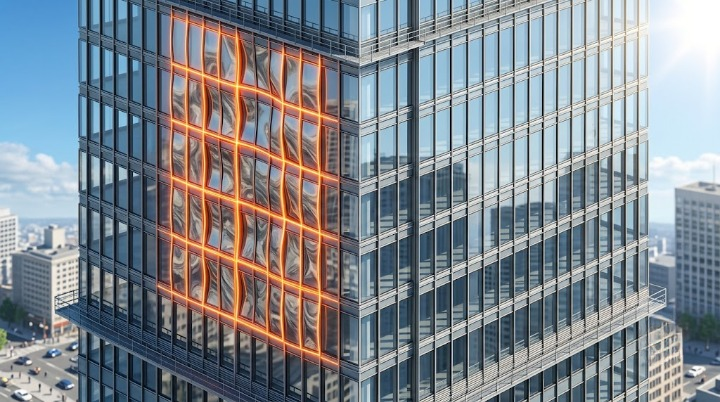
The sight of a buckled aluminum facade isn’t just an aesthetic failure; it’s a legal and financial liability. Every “wave” visible in the cladding under direct sunlight serves as evidence of an engineering oversight by the contractor or fabricator.
Preventing facade buckling begins at the acp cladding work specification phase, where ignoring the physics of aluminum movement leads to project rejection and expensive re-fabrication.
The Liability of Buckling – When Facades Wave Under the Sun
Facade buckling, often described as “oil-canning,” occurs when the material expands beyond the limits of its fixing system.
In extreme temperature variations, a 4-meter aluminum composite panel can expand by approximately 4.8mm.
If your movement joints are insufficient, the internal pressure forces the panel to bow outward, leading to permanent deformation and potential structural failure. Managing this movement is a mandatory safety requirement, not an aesthetic choice.
What are the standard expansion gap requirements for ACP cladding?
According to CladCut’s precision engineering protocol, thermal expansion gaps must be calculated based on panel length and the local climate’s temperature range to ensure facade stability:
- 3m Panels: Require a minimum 6mm expansion joint to prevent edge contact.
- 4m Panels: Require a minimum 8mm to 10mm expansion joint to accommodate linear movement.
- 6m Panels: Require a minimum 12mm to 15mm expansion joint for high-rise or large-scale applications.
- Calculation Logic: These specifications are based on a thermal expansion coefficient ($\alpha$) for aluminum of approximately $24 \times 10^{-6}/^\circ C$.
Engineering Diagnosis – The Physics of Motion in Cladding Specs
The coefficient of linear thermal expansion is the most critical variable in facade longevity.
A gap between panels is a structural safety valve that prevents bi-metallic stress and panel warping.
Accurate joint spacing must account for the peak temperature of the aluminum surface, which can exceed ambient air temperature by $30^\circ C$ or more. Proper cladding tolerances are not suggestions; they are engineering mandates that dictate the total cladding work specification.
Stop Guessing Thermal Gaps
Relying on manual estimations for movement joints is an operational risk that no modern fabricator should take.
Traditional methods often lead to inconsistent tolerances that result in project delays during the inspection phase. However, you can eliminate this uncertainty by integrating algorithmic simulation into your workflow.
A precise acp cladding work specification ensures that every movement joint is validated against physical constants before the first sheet is cut. This transition from “guessing” to “verifying” is the only way to guarantee a buckle-free facade.
[إشارة للناشر: تم دمج نص الرابط (Anchor Text) في الجملة السابقة. يرجى تفعيل الرابط التشعبي على الكلمات التالية تحديداً: “acp cladding work specification” وتوجيهها للرابط الهدف.]
CladCut – The Guardian of Structural Integrity
CladCut provides the certainty needed to handle complex thermal dynamics. Our engine automatically factors in required sheet margins and bend allowances while maintaining the mandatory movement joints.
- Automated Compliance: CladCut’s logic is built on engineering standards, ensuring your shop drawings pass consultant review without corrections.
- ROI Optimization: Eliminate the cost of re-fabricating buckled panels by getting the tolerances right the first time.
- Zero-Error Nesting: The software optimizes the 2D layout while strictly respecting the required expansion gaps between every panel ID.
The Grand Finale – Precision is Profit
A perfect facade lives for decades; a failed one is a permanent stain on your professional reputation.
In the cladding industry, a single millimeter of error can cost an entire project. Choosing a system that understands the physics of thermal expansion isn’t just about compliance; it’s about protecting your ROI.
Stop paying for thermal errors. [Download Thermal Expansion Guide] and start engineering with zero-error certainty.
Engineered FAQ
- How do I calculate thermal expansion for a 4m panel?
Thermal expansion is calculated by multiplying the panel length by the temperature difference and the coefficient 0.024 mm/m/^\circ C.
A 50^\circ C change results in nearly 4.8mm of movement.
- Can joint gaps be reduced for aesthetic reasons?
No. Reducing gaps below the engineered requirement leads to buckling and catastrophic facade failure. Aesthetics must follow engineering physics.
- Does CladCut support Saudi Building Code (SBC) standards?
Yes. CladCut is designed to meet strict engineering mandates, providing the technical rigidity required for SBC-compliant projects.