
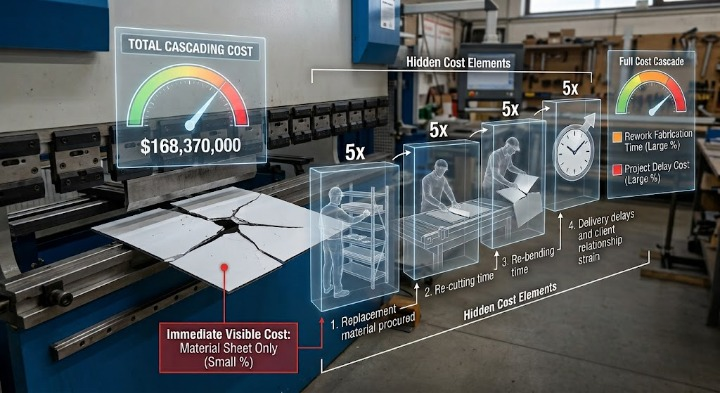
Workshop owners dismissing panel breakage as an acceptable cost of doing business often have not calculated the full cascade of replacement material, re-cutting time, re-bending time, and delivery delay that follows a single broken panel.
Why a Broken Panel’s Cost Extends Far Beyond the Sheet
The immediate, visible cost of a broken panel is the material itself — but this represents only a fraction of the total cost cascade. Replacement material must be procured and cut again, re-bending consumes additional labor time, and the delay this introduces can ripple into delivery schedules and client relationships in ways that are harder to quantify but no less real.
Where This Full Cost Goes Uncalculated
Workshop owners tracking panel breakage typically note the material cost as the primary metric, without extending that calculation to include the labor hours consumed by rework, the schedule impact of the delay, and the potential strain on client trust if the delay affects a delivery commitment.
Why Underestimating This Cost Leads to Under-Investment in Prevention
If the true cost of panel breakage is systematically underestimated, the case for investing in prevention — through more precise bending calculations, for instance — appears weaker than it actually is, leading workshops to accept a breakage rate that a fuller cost accounting would justify addressing directly.
Preventing Breakage at Source Through Precise Bending Calculation
After breaking down the full cost cascade of a single broken panel, the fix is preventing breakage before it occurs, rather than continuing to absorb its full cascading cost. Clad Cut V2’s automated bending allowance calculator computes precise K-Factor and bend deductions for every panel before cutting begins, addressing breakage at its root cause rather than managing its downstream cost.