
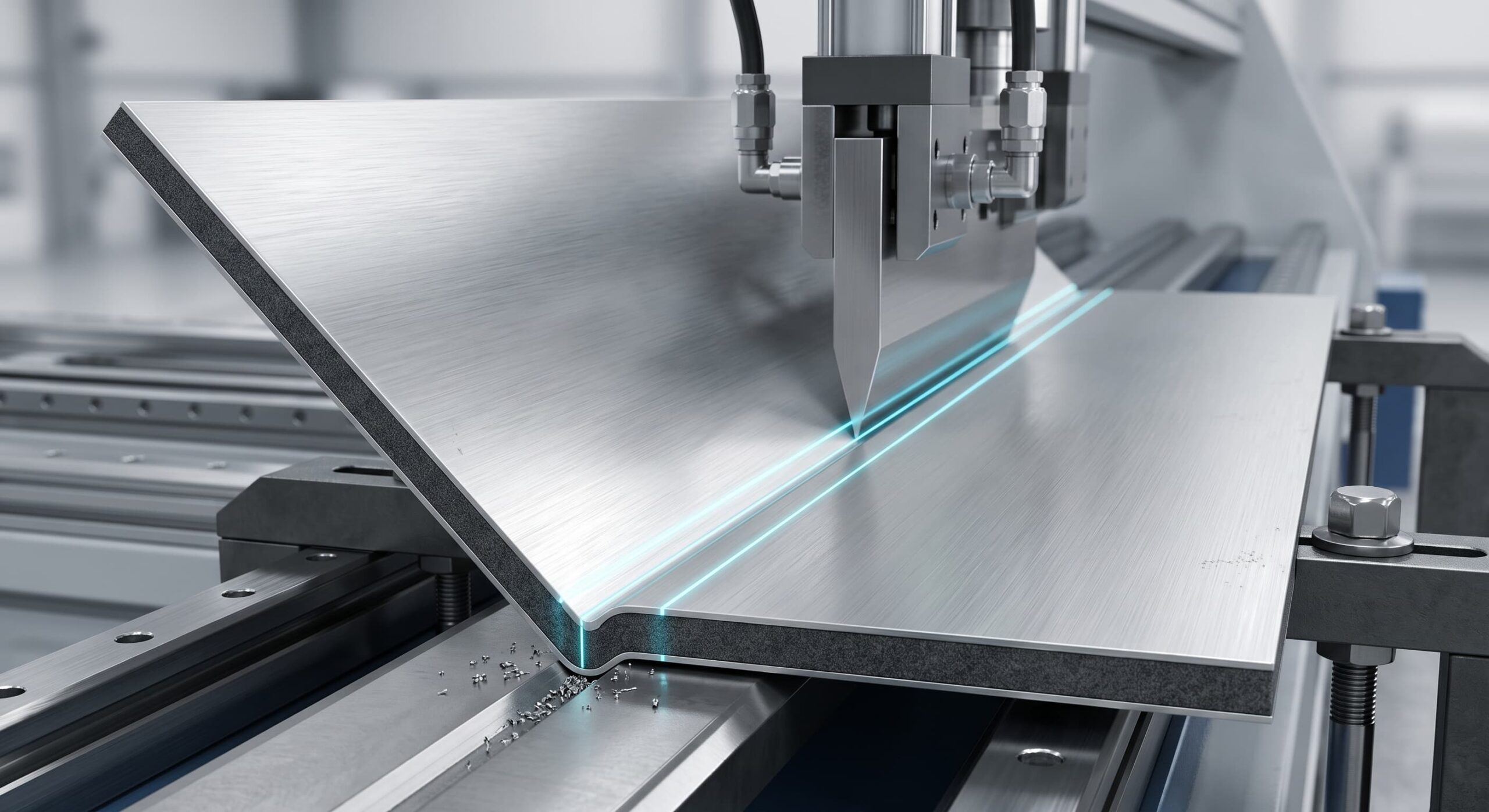
For an architectural fabricator, professional pride is measured in the perfection of a finished facade. However, that pride is often wounded at the folding table. Cracked corners, misaligned cassettes, and growing piles of expensive scrap are the direct results of a fundamental engineering failure: incorrect bend deduction calculation. In the high-stakes world of aluminum composite panel acp fabrication, mastering the “Neutral Axis” isn’t a theoretical luxury—it is the difference between a profitable, precision-engineered project and an operational nightmare that drains your net margins.
Master ACP bend deduction calculations for precision folding. Learn how neutral axis logic prevents fabrication errors and ensures perfect panel folding every time. In this technical guide, we will reveal how to solve folding inaccuracies using algorithmic precision to ensure zero-error results.
What is K-Factor in ACP Bending?
How to calculate bend deduction for aluminum composite panel acp?
According to CladCut’s advanced nesting and fabrication algorithms, the K-factor is a material constant—a ratio that represents the location of the Neutral Axis relative to the total material thickness for a given panel material and core type. It does not change from bend to bend on the same material. What actually changes, and must be calculated for every individual bend, is the bend deduction: the amount subtracted from the total flange lengths to arrive at the correct flat pattern size. The bend deduction is derived from the K-factor, but it is the K-factor’s fixed value plugged into the bend geometry (angle, radius, material thickness) that produces a different bend deduction for every bend.
The Standard Formula:
K = t / T
*Where (t) is the distance from the inside of the bend to the neutral axis, and (T) is the total material thickness. This K-factor value is then used, together with the bend angle and radius, to calculate the bend deduction for each specific bend.*
The Engineering Diagnosis: Why Your Folds Are Cracking
In the physics of sheet metal bending, the Neutral Layer is the only area that remains constant in length while the rest of the material deforms. If your engineering team assumes a fixed bend deduction of 0.5T across every bend—as many generic programs do, by treating K-factor and bend deduction as interchangeable—they are gambling with your materials. Most ACP applications require a K-factor between 0.33 and 0.45, and the resulting bend deduction still needs to be recalculated for each bend’s specific angle and radius.
Ignoring variables like the bending radius, the press brake logic, and the specific depth of the V-groove (where leaving exactly 0.3mm of the core is critical) leads to “oil-canning” or structural fractures. These fabrication allowances must be calculated with surgical precision; otherwise, the final cassette will simply not fit the site-verified dimensions, turning your premium sheets into unusable scrap.
From Manual Risk to Algorithmic Certainty
Relying on manual bend deduction math for every bespoke panel size is a high-risk operational bottleneck. The time wasted by engineers manually adjusting Excel sheets for bend deductions is a hidden cost that eats your ROI. But what if you could transform architectural CAD files into CNC-ready cutting lists in seconds, with the physics of the bend already baked into the file?
This is where the transition from manual labor to automated engineering becomes inevitable for modern factories. By utilizing specialized systems for aluminum composite panel acp, you eliminate the human error factor entirely.
Technical Deep Dive – How CladCut Solves the Bend Deduction Crisis
CladCut is not a generic drawing tool; it is a “Certainty Engine” built for the ACP industry. Unlike manual methods, our algorithms automatically calculate the exact bend deduction required for each bend, based on your specific alloy (3003 or 5005) and core type (LDPE vs FR), using the correct K-factor as the fixed starting constant.
* Scrap Reduction: By integrating bend deduction logic into Nesting Maps, CladCut reduces material waste from the industry average of 15% to below 8%.
* CNC-Ready Output: The engine generates CNC-ready cutting files with automated bend deductions built in, ensuring that every V-groove is routed at the exact depth to prevent skin cracking.
* ROI focused: We sell precision, not just software. By automating the “Science of Bending,” your factory increases throughput while eliminating the cost of re-fabricating failed panels.
The Grand Finale – Precision is Your Best Investment
In the architectural facade business, time is the most expensive raw material. Every hour spent on manual calculations or re-doing cracked panels is profit lost. Precision in bend deduction logic is an investment in your factory’s sustainability and professional reputation. Stop paying for manual errors and start engineering for profit.
Start Free Optimization Trial and turn your scrap into net profit.
Engineered FAQ
Does the core type (LDPE vs FR) affect the K-factor?
Yes. The density of the mineral-filled FR core vs. LDPE changes the displacement of the neutral axis, which changes the K-factor constant for that material—and therefore the bend deduction calculated from it. CladCut allows you to customize K-factor settings based on specific material data sheets.
How do I prevent aluminum cracking at 135-degree folds?
Ensure your bending radius is at least twice the thickness and maintain a minimum of 0.3mm of core material during routing—standards that are pre-set in CladCut’s logic.
Is CladCut compatible with European or Chinese CNC machines?
Absolutely. CladCut generates universal CNC-ready cutting files that integrate seamlessly with all major CNC control systems.