
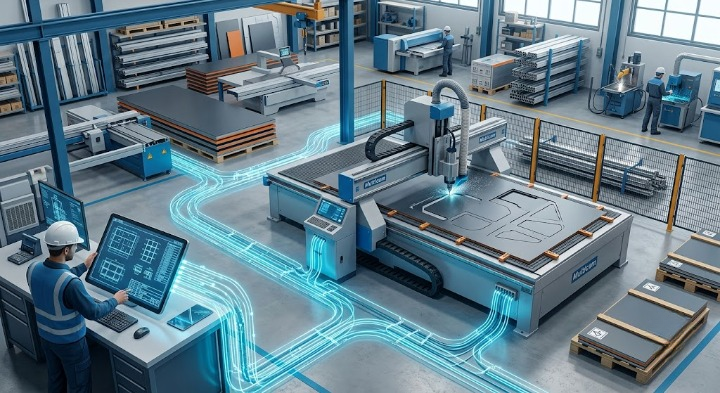
The gap between a beautiful AutoCAD design and a successful site installation is often filled with expensive rework and operational chaos. For factory managers, the nightmare begins when “office dimensions” clash with “site reality,” leading to misaligned cassettes and mounting scrap piles.
This disconnect isn’t just a technical error; it is a failure in the fabrication protocol that drains net profit. To achieve a seamless aluminium fabrication process, you must replace manual estimation with a structured, automated workflow that ensures what is drawn is exactly what is installed.
What are the stages of the ACP fabrication cycle from design to site?
According to CladCut’s automated fabrication algorithms, a professional aluminium fabrication workflow must follow these 7 mandatory steps to ensure zero-error field delivery:
- Site Survey: Accurate as-built measurements of the actual facade.
- Engineering Design: Aligning structural requirements with the Saudi Building Code (SBC).
- Shop Drawings for ACP: Generating detailed, millimetric execution plans.
- Material Selection: Identifying sheets and verifying Grain Direction.
- Optimization (Nesting): Mathematically arranging cassettes to minimize scrap.
- Routing & Folding: Precision cutting and V-grooving via CNC machines.
- CNC-Ready File Generation: Converting digital data into machine-ready cutting instructions.
The Engineering Diagnosis – Why Traditional Logistics Fail
In the world of facade engineering, a 1mm error in routing and folding is enough to invalidate an entire panel assembly. Traditional workflows rely too heavily on the manual translation of shop drawings for ACP into cutting lists. This human-dependent bridge is where most profit is lost.
Without integrating site measurements directly into the optimization phase, the factory remains isolated from the building’s physical reality. Fabrication logistics fail not because of machine speed, but because of data inaccuracy.
When your workshop lacks a unified “source of truth,” your engineers spend 80% of their time fixing errors rather than overseeing production.
Moving to an automated protocol is the only way to ensure that the fabrication workflow remains a path to profit rather than a cycle of rework.
Transitioning to Automated Certainty
Stop the back-and-forth between the office and the site. The real bridge to efficiency is an automated fabrication workflow that synchronizes as-built data with CNC production.
Modern[aluminium fabrication no longer depends on the “intuition” of a technician; it relies on the mathematical certainty of a cloud-based engine.
Product Deep Dive: CladCut as Your Logistics Command Center
CladCut is engineered to act as the central nervous system of your factory. It transforms architectural intent into mechanical execution with zero human intervention in the calculation phase.
* ROI Driven: CladCut reduces office engineering hours by up to 80%, allowing your team to handle five times the project volume.
* Zero-Error Nesting: Our algorithms calculate the highest possible Yield, ensuring every square meter of your aluminium fabrication material is utilized effectively.
* CNC Precision Mastery: The system doesn’t just “draw”; it generates precise CNC-ready cutting files that control your router’s entry points (Lead-in/Lead-out) and V-groove depths, preventing skin cracking and material failure.
Order is the Highest Currency
Success in facade delivery is decided before the first panel arrives at the site. Wasted time in municipality reviews or site rework is profit that never returns. By integrating an automated workflow, you transform your workshop from a place of “manual effort” into an “engineering powerhouse.” Stop letting chaos run your factory; take control of your margins today.
Download Fabrication Workflow PDF and start engineering your project for 100% certainty and maximum profit.
Engineered FAQ
Is the system compatible with all CNC machines?
Yes. CladCut generates universal, CNC-ready cutting files compatible with all major control systems, ensuring a seamless link between software and hardware.
How do we ensure drawings match site reality?
Our protocol allows for the direct import of site measurements, which automatically updates the shop drawings and nesting maps before the final cut.
Does the software support folding direction calculations?
Absolutely. CladCut pre-calculates routing and folding paths to ensure that the aluminum skin remains intact and consistent with material orientation requirements.