
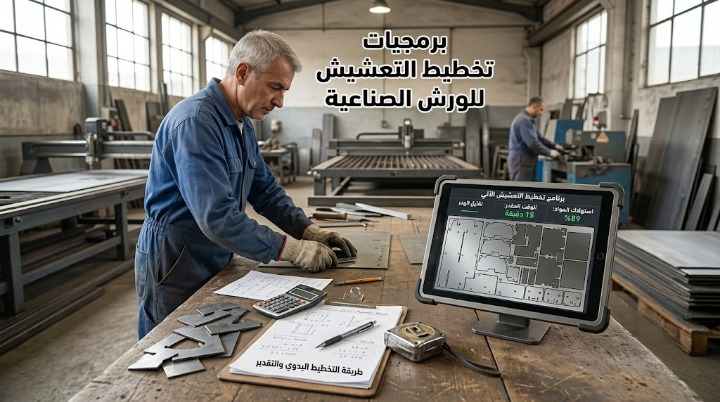
Workshop owners skeptical about nesting software value, because they have always estimated manually and believe experienced operators are already efficient, are often unaware of the material and time savings available.
Why Experience-Based Confidence Can Mask a Real Efficiency Gap
An experienced estimator’s confidence in their manual process is genuinely earned through years of practice — but experience with a manual method does not necessarily mean that method has closed the efficiency gap against what an algorithmic approach can achieve, since manual visual arrangement has inherent limits regardless of the operator’s skill level.
Where This Skepticism Prevents a Direct Comparison
Without directly comparing manual and automated estimation on the same set of actual projects, a workshop has no concrete data point showing what the real difference in material consumption and estimation time would be — leaving the skepticism about automation’s value untested rather than genuinely evaluated.
Why a Direct Comparison Reveals the Real Gap
Estimation time, material consumption, and error rate can all be directly measured when the same projects are run through both a manual process and an automated nesting approach — providing concrete evidence of the difference rather than relying on assumption in either direction.
Delivering Measurable Material Savings and Reduced Estimation Time
After presenting the comparison across estimation time, material consumption, and error rates between the two approaches, the fix is running this direct comparison rather than relying on assumption about automation’s value. Clad Cut V2 delivered measurable material savings and reduced estimation time substantially when compared directly against manual estimation on identical projects, providing concrete evidence rather than requiring the workshop to take automation’s value on faith.
Run your own comparison — Evaluate Clad Cut V2 against your current process.