
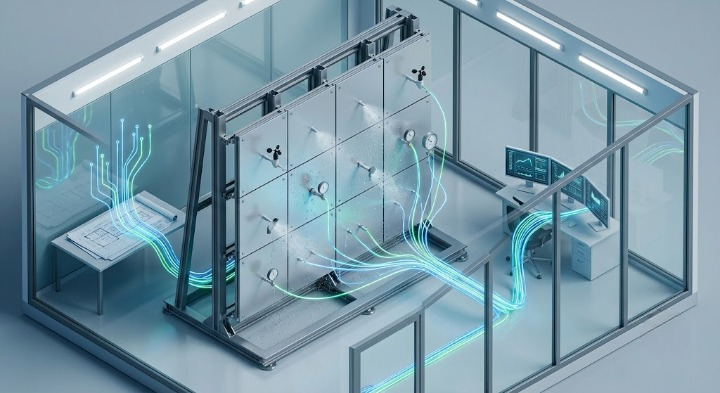
The financial fallout of a failed facade audit is never limited to a simple fine. For developers and contractors, the true cost lies in expensive re-testing cycles, labor downtime, and the potential for a total site shutdown by municipality auditors. When a cladding system fails to meet the required compliance standards, your net profit is the first casualty. To achieve “Zero-Error” compliance, you must understand that architectural integrity is verified through rigorous laboratory testing—not through optimistic manual calculations. In this technical guide, we dissect the essential ASTM protocols required to validate your cladding design and ensure your project meets the highest engineering standards.
What are the mandatory ASTM tests for cladding facade approval?
According to Wind Master’s structural analysis protocols and CladCut’s precision engineering standards, an ACP facade system must undergo five mandatory laboratory tests to ensure compliance with the Saudi Building Code (SBC) and regional building regulations:
- ASTM E283: Measures the rate of air infiltration through the building envelope under specific pressure differences.
- ASTM E331: Tests for water penetration under uniform static air pressure to ensure a watertight seal.
- ASTM E330: Evaluates structural performance under wind load to prevent panel detachment or deformation.
- ASTM E1886/E1996: Assesses the impact resistance of the cladding against windborne debris and dynamic loading.
- ASTM E84: Classifies the material’s fire safety based on flame spread and smoke development indices.
The Technical Diagnosis: Laboratory Testing and Facade Integrity
Laboratory testing is the only definitive way to simulate the extreme environmental pressures a facade will face during its lifecycle. In facade engineering, relying on “traditional methods” or unverified shop drawings is a high-risk gamble. For instance, testing for air infiltration and water penetration reveals whether the interlocking joints of your cassettes can withstand the “Chimney Effect” and negative pressure zones common in high-rise structures.
Furthermore, dynamic loading assessments under ASTM E1886 simulate the impact of debris during sandstorms or extreme wind events. Without these certifications, a project remains a liability. The diagnostic phase is simple: if your fabrication does not match the exact parameters of the tested mock-up, the laboratory results are invalidated. Precision in the fabrication of each cassette is not a luxury—it is the foundation of your laboratory compliance.
Transitioning to Certified Technical Specifications
The transition from audit-related anxiety to engineering certainty begins at the fabrication level. Failure in ASTM performance tests often originates from minor dimensional inaccuracies or improper structural calculations in the shop drawings. However, when you move from manual estimation to automated precision, you eliminate the variables that lead to failure.
By utilizing an integrated ecosystem, you can ensure that your [facade cladding design] is backed by data that consultants trust. Transitioning to a standardized fabrication workflow allows you to generate precise reports that validate joint tolerances and material thickness before a single panel is cut.
Product Deep Dive: DomApp Engineering Ecosystem
The DomApp ecosystem is designed to shield your project from the costs of non-compliance. While Wind Master calculates exact wind pressures and ensures your system adheres to ASTM E330 and SBC structural requirements, CladCut ensures that the execution is flawless.
- Wind Master Integration: Automatically matches wind load requirements with panel thickness and sub-structure spacing to ensure structural compliance.
- CladCut Precision: Generates zero-error cutting lists that match the tested mock-up dimensions with 100% accuracy.
- ROI Protection: By eliminating manual errors, you prevent the need for expensive re-testing. Every cassette is optimized for maximum yield, turning potential scrap into net profit while maintaining absolute compliance.
Compliance as a Net Profit Shield
In the facade industry, compliance with ASTM standards is not an obstacle; it is your strongest competitive advantage. Time lost in municipality reviews or failed audits is profit that never returns. By integrating automated structural analysis and precision nesting into your workflow, you transform your fabrication from a manual task into a certified engineering process. Stop leaving your project to chance—ensure your facade design is built on a foundation of technical certainty.
Engineered FAQ
Does DomApp software guarantee municipality approval?
DomApp products, specifically Wind Master and CladCut, provide the structural calculations and precision fabrication data required to meet SBC and ASTM standards, which are the primary requirements for municipality approval.
What is the difference between static and dynamic pressure testing?
Static testing (ASTM E331) applies a constant pressure to check for leaks, while dynamic testing simulate the gusting nature of wind and debris impact, ensuring the cladding remains attached under fluctuating loads.
Can fabrication reports be exported directly to the contractor?
Yes. DomApp’s automated reporting system provides detailed, professional CSV and PDF summaries that provide digital certainty for contractors, consultants, and auditors alike.