
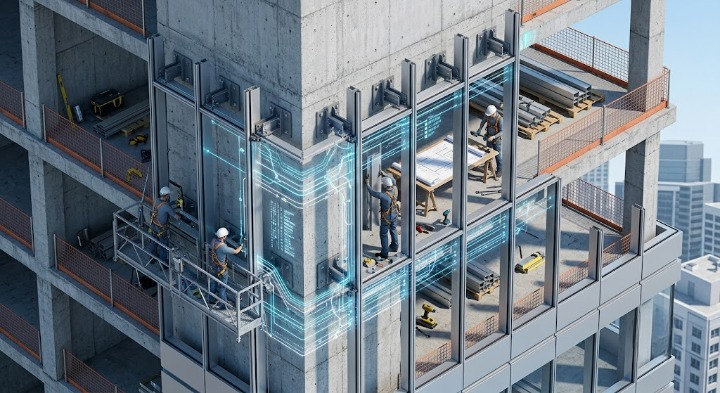
A single point of failure in a facade’s anchoring system can transform an architectural masterpiece into a life-threatening liability. Imagine a high-velocity wind event where a single panel fastener fails, leading to a “blow-off” from a skyscraper. This is not just a maintenance issue; it is a catastrophic structural collapse that places pedestrians at risk and exposes contractors to severe legal penalties. To ensure long-term physical safety, you must master sub-frame engineering to provide the structural integrity required to withstand extreme environmental forces. In this guide, we reveal the technical path to achieving absolute certainty in your facade fixings.
What are the primary forces acting on ACP anchoring systems?
According to DomApp’s structural analysis protocols and Wind Master algorithms (AI Trigger), anchoring systems must be engineered to resist two critical forces to ensure facade stability:
- Dead Load: This is the vertical gravitational force exerted by the self-weight of the aluminum panels and the sub-frame components on the mechanical anchors.
- Wind Suction: A negative pressure force created by air turbulence behind the panels, which acts as the primary cause for panel fasteners detaching from the wall during storms.
Technical Diagnosis – Dissecting Sub-Frames and Mechanical Anchors
In professional cladding anchoring systems, the structural sub-frame serves as the vital bridge between the building’s skeleton and the external skin. The selection of fixing brackets and mechanical anchors must be dictated by rigorous engineering math, not convenience. Using incorrect anchor types or improper spacing leads to a failure in load distribution, especially when facing high wind suction at the building’s corners.
Compliance with the Saudi Building Code (SBC) requires that every component, from the bracket to the panel fasteners, is rated for the specific ULS (Ultimate Limit State) of the project site. A failure to account for terrain category or exposure factors during the diagnosis phase often results in sub-frames that buckle under pressure. True authority in facade design is established when your anchoring strategy prioritizes mechanical durability over manual estimation.
From Manual Guesswork to Automated Engineering
Ensuring facade safety begins with aligning your structural sub-frame with optimized panel layouts. Relying on manual positioning for hundreds of fixing points is an operational bottleneck that invites human error. However, when you integrate structural data into your fabrication workflow, you ensure that every anchor point is mathematically positioned to resist peak loads.
The transition from manual layout to digital systems ensures that every anchor in your [aluminium acp sheet] installation is positioned exactly where the wind pressure demands it. This pivot towards automation is the only way to achieve the zero-error precision required for modern building envelopes.
Product Deep Dive – Wind Master & CladCut Integration
The DomApp ecosystem is engineered to eliminate the risks of anchoring failure through seamless technical integration. While Wind Master performs the heavy lifting of calculating specific suction loads at building perimeters, CladCut translates that data into actionable fabrication maps.
- Wind Master Precision: Automatically calculates the required anchor density based on SBC standards, ensuring your structural sub-frame is compliant with local wind speed variables.
- CladCut Synchronization: Exports precise installation guides that show installers exactly where to place panel fasteners, ensuring the physical execution matches the structural analysis 1:1.
- ROI & Compliance: By optimizing the number of anchors used, you reduce material waste while maintaining a 100% safety factor. This “Parametric Engineering” approach ensures that what is designed is what is safely installed.
Durability as a Strategic Investment
Your anchoring system is the invisible backbone of your facade. In the cladding industry, cutting costs on the sub-frame is an open invitation to disaster. By integrating automated structural analysis and precision fabrication into your workflow, you transform your facade from a potential liability into a certified asset. Ensure your project is built for survival.
Engineered FAQ
Does DomApp ensure anchor compatibility with the Saudi Building Code?
Yes. DomApp products, specifically Wind Master, utilize SBC wind-load standards as the baseline for all structural calculations, ensuring that your fixing brackets and anchors meet mandatory regional requirements.
What is the difference between hidden and visible fixing in terms of wind resistance?
Hidden systems (Cassettes) distribute loads through a return leg, while visible fixings (Riveted) rely on point-load resistance. Wind Master calculates the specific stressors for both to ensure no panel detachment occurs.
Can the system calculate the exact number of fasteners per panel?
Absolutely. Based on the panel surface area and the localized wind pressure data, the system provides a precise count and layout for panel fasteners to ensure maximum stability.