
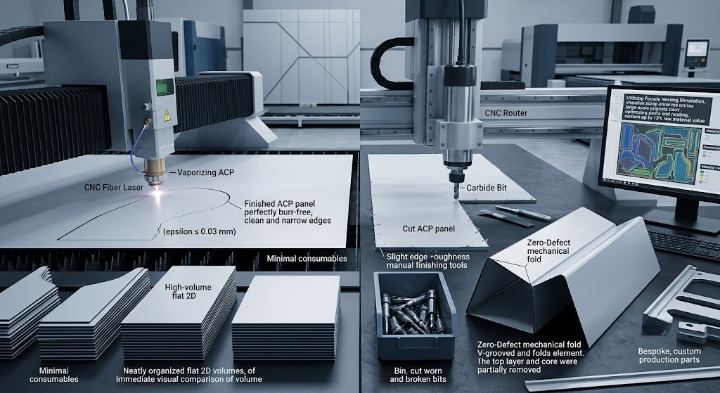
In 2026, the selection of fabrication technology is no longer a matter of preference—it is a rigorous engineering decision aimed at achieving “Technical Certainty” for every panel that leaves the production line. For engineers and manufacturers, the choice between a CNC Router and a CNC Fiber Laser for cutting Aluminium Composite Panels (ACP) is a trade-off between absolute precision and functional versatility.
ACP Aluminium Cutting: The 2026 Technical Face-Off
The choice between Laser and Router depends on physical variables, including the ACP aluminium sheet thickness and the complexity of the architectural design.
1. Edge Quality and Precision
In projects requiring micron-level accuracy, the fundamental difference lies in the “Error Coefficient”:
- Fiber Laser: Offers exceptional positioning accuracy of up to $\epsilon \le 0.03$ mm. This results in perfectly clean, burr-free edges by melting and vaporizing material in a very narrow path. This eliminates the need for secondary finishing operations and drastically reduces operational waste.
- CNC Router: Relies on a mechanical “Carbide Bit.” For larger thicknesses, some roughness may occur due to tool vibration or wear. This often necessitates manual deburring or smoothing, especially in intricate ACP aluminium sheet designs.
2. Operating Economics (ROI Analysis)
| Feature | CNC Fiber Laser | CNC Router |
| Capital Expenditure | High (Long-term strategic investment). | Low to Moderate. |
| Consumables | Minimal (No cutting bits required). | High (Continuous carbide bit replacement). |
| Productivity | Ideal for High-volume production. | Ideal for Bespoke or custom production. |
| Functional Range | Limited to 2D flat cutting. | V-Grooving, drilling, and blind holes. |
V-Grooving – The Router’s Competitive Edge
This is the primary technical bottleneck: if your project relies on folding panels to form 3D boxes or sharp architectural corners, the CNC Router is essentially the only viable option. While a Laser cuts through the panel entirely, a Router can remove the top aluminium layer and a portion of the core (LDPE) while leaving the bottom skin intact. This ensures a precise, Zero-Defect mechanical fold.
G-code Optimization – The Language of Machining
Regardless of the machine you choose, the quality of the output depends on G-code optimization. Optimized code is more than just a path; it is a strategy for managing heat distribution and preventing the core of the ACP Aluminium Composite Panel from melting due to friction or dwell time.
“Utilizing Facade Nesting Simulation allows you to visualize expected scrap before the first cut is made. In large-scale projects, optimizing paths and nesting can reclaim up to 15% of raw material value.”